Trenchless Sewer Line Replacement in Sherman Oaks: 2026 Cost Breakdown, Savings, and What to Expect
Trenchless Sewer Line Replacement in Sherman Oaks: 2026 Cost Breakdown, Savings, and What to Expect
Trenchless sewer line replacement in Sherman Oaks has moved from niche option to standard practice because the housing stock and landscaping make open-trench excavation a last resort. A large share of properties in zip codes 91423 and 91403 still run on vitrified clay tile laterals from the 1940s to 1960s. That material is at or past service life in San Fernando Valley soil, and root intrusion from mature ficus, sycamore, and magnolia trees along Hazeltine Ave, Kester Ave, and Woodman Ave makes the failure curve steeper each year. Owners who replace those laterals now are choosing trenchless methods that preserve driveways, patios, and gardens while cutting the project timeline by several days compared to open cut.
Why Sherman Oaks sees more trenchless work than almost anywhere else in Los Angeles
Most blocks south of Ventura Boulevard were built long before ABS and PVC became standard. Many laterals still follow original clay tile paths that run under large jacaranda or ficus roots, across front lawns, and beneath driveways to the LA County Sanitation main. Those laterals are not just old. They sit in active root zones and often lack modern cleanouts. When fractures, offset joints, or a partial collapse start causing backups, excavation would cut through concrete and mature landscaping. That is wasteful on properties where the replacement pipe can be pulled or lined through existing runs with almost no surface disruption.
Sherman Oaks also carries high property values and high restoration costs. A cracked driveway panel on a Valley Vista home is not a minor budget line. The same applies to hardscape in Longridge Estates or Royal Woods. Trenchless methods avoid most of that restoration. On a 1952 ranch in 91423 with a 55 foot clay lateral under a concrete driveway, pipe bursting replaces the line in one to two days with only two small access pits. Open-trench work on the same property would be five to seven days and would add several thousand dollars in concrete demolition and re-pour before landscape repair even starts.
Housing archetypes and what they mean for trenchless specification
Sherman Oaks has a diverse mix of residential archetypes, and each one pushes trenchless design choices in a different direction. Post-war ranch homes from the 1940s and 1950s in central 91423 usually have clay tile laterals with 4 inch diameter, sometimes increasing to 6 inch at the property line. Mid-century split-levels in the hillside 91403 corridor often carry cast iron drain stacks in the house with a transition to clay or early ABS in the yard. 1980s through 1990s redevelopments in Sherman Oaks Hills and Valley Vista tend to have ABS or PVC laterals already, though joints and sags can still cause bellies and chronic blockages. Spanish Revival and older cottages near Magnolia Woods and Chandler Estates may have a patchwork of materials from prior spot repairs. The correct trenchless method rests on what the inspection finds at each transition, each bend, and the condition of the host pipe.
Soil conditions also matter. Valley clays expand and contract with moisture swings that follow winter rains and dry summers. That movement opens joints in clay tile and can create bellies where bedding was light or settles near the curb. Hillside lots above Ventura Boulevard sometimes introduce sharper bends as laterals drop to the main in the street, which influences whether cured in place pipe lining or pipe bursting is the safer choice.
How a professional inspection sets the method and scope
A complete diagnosis comes first. A sewer camera inspection documents pipe material, diameter, length, and failure mode. A RIDGID SeeSnake or similar camera passes from a cleanout to the municipal tap while the technician records footage and measures distance. The inspection confirms whether the lateral is clay tile, cast iron, ABS, PVC, or a mixture. It also flags root intrusion, offset joints, cracks, a bellied section that holds water, or a full collapse. The result is a data set that determines method and cost. For example, a 48 foot run of clay tile with root intrusion and offset joints but no belly or collapse usually favors pipe bursting. A longer run with intact but porous clay tile under a decorative circular driveway might favor CIPP lining to avoid any risk to pavers.
Hydro jetting often comes next, especially if root mats or grease are present. A hydro jet at 4000 PSI with appropriate root cutter or chain flail nozzle restores the internal diameter and removes intrusions so the camera can confirm clean host pipe walls. For CIPP, this prep work is essential because the liner bonds to a clean surface. For bursting, the goal is better visibility and reduced risk when the bursting head passes joints and turns.
Method selection in Sherman Oaks: pipe bursting vs CIPP lining
Trenchless work in this neighborhood centers on two methods. Pipe bursting removes the old pipe by pulling a conical bursting head through the existing lateral while a new HDPE pipe follows in its path. CIPP, or cured in place pipe, inserts an epoxy-saturated liner into the host pipe and cures it to create a new pipe within the old one.
Pipe bursting replaces the old lateral with a seamless HDPE pipe fused in pipe replacement Sherman Oaks CA the yard to the exact length. The new pipe comes with heat-fused joints that do not leak and do not attract roots. ASTM F1962 sets the design and installation standard for bursting. In Sherman Oaks, this method suits fractured clay with heavy root intrusion or brittle Orangeburg segments still found in a few 1950s properties. It also suits laterals under lawns or softscape where two small access pits are easy to patch. It can handle long straight runs and standard bends, though constraints increase with tight S-curves or very shallow depths beneath load-bearing footings.
CIPP lining rehabilitates the existing run. The service team inverts or pulls a felt-and-epoxy liner into place, inflates a calibration tube, and cures it under heat or ambient conditions depending on resin. ASTM F1216 governs the liner design. In Sherman Oaks, CIPP is a strong fit when the lateral passes under a high-value driveway, a brick or stone patio, or protected tree roots that no one wants to disturb. A well-installed liner eliminates infiltration, seals joints, and smooths internal walls. It is not a cure for a flat belly or a total collapse. The host pipe must maintain shape and grade. Lining also needs careful attention at tie-ins and transitions to avoid lip formation where branch lines meet the main lateral.
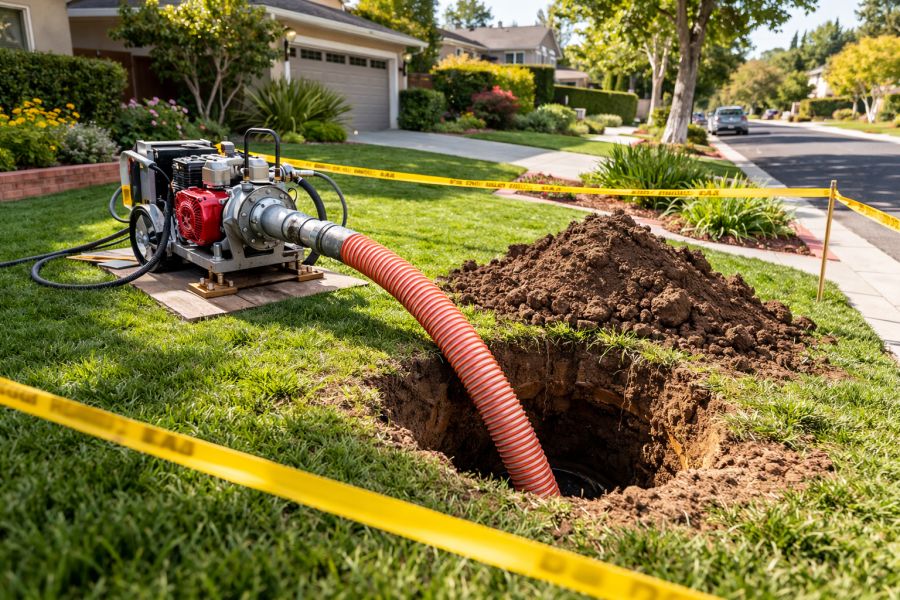
ServiStar technicians also evaluate spot repairs and short-run replacements where a small segment has failed near the house or near the curb. Sometimes a short open-trench dig paired with a partial CIPP or a short bursting run gives the best result. The camera footage and property layout drive that decision.
How local corridors change the plan
South of Ventura Boulevard, many laterals run beneath driveways before dropping to the main in the street. Properties near Westfield Fashion Square and the Sherman Oaks Galleria often combine thin lawn setbacks with wide concrete drives. Those sites press the case for CIPP lining more often because a liner passes under concrete without a saw cut. Homes along Hazeltine Ave and Kester Ave sit under mature canopies that drive root intrusion. Those lines tend to favor pipe bursting to remove the old tile entirely and install HDPE that roots cannot penetrate. The Valley Vista and Royal Woods hillside tracts add another variable. They often require careful pull planning to avoid stressing old bends. On those lots, a short open pit at a turn followed by a staged burst or a sectional liner avoids pushing forces through tight geometry.
In central 91423 near Riverside Drive and Chandler Estates, builders often set laterals at moderate depth with a straight shot to the main. Bursting there is fast and cost-effective. In 91403 hillside lots near Mulholland Drive, depths and slopes increase, so access pit placement and safety matter. The team must establish shoring and meet California Plumbing Code trench safety rules. Those job sites take more onsite planning and can extend to two or three days rather than one.
Permits, inspections, and local compliance
Trenchless sewer line replacement in Sherman Oaks requires proper permits and inspections. The Los Angeles Department of Building and Safety issues the plumbing permit for private property work. The LADBS Van Nuys office processes most Sherman Oaks permits. For full lateral replacement or major rehabilitation, LADBS inspects the access pits, the pipe material, the connections, the cleanout, and the backwater valve if installed. The inspector must sign off before backfill. LA County Sanitation has jurisdiction on the public main. Replacement does not extend into the main, but the line must maintain the required slope and alignment to the tap. Where a property sale triggers lateral compliance in certain Sanitation District overlaps, a sewer camera inspection report can be required at point of sale. ServiStar manages permits, coordinates the inspection schedule, and documents the final work for owner records and, if relevant, for escrow.
Code details matter on every project. California Plumbing Code sets slope, cleanout placement, and material standards for laterals. Many Sherman Oaks homes still lack a modern, accessible cleanout. Adding one near the house and one near the property line speeds future service and is recommended when replacing a lateral. Where flooding history exists, a code-compliant backwater valve prevents municipal surges from pushing sewage back into the home. LADBS requires that valve to be accessible for maintenance and placed per code elevation rules. Work near gas service requires respect for SoCalGas set-backs and utility locates. ServiStar technicians run utility mark-outs before digging access pits and set barricades on narrow streets per City of Los Angeles requirements.
2026 cost breakdown for trenchless sewer line replacement in Sherman Oaks
Costs in 2026 reflect both local conditions and material markets. HDPE, epoxy resin systems, and labor all price higher than five years ago, but trenchless still comes out ahead once restoration is included. The baseline project in central Sherman Oaks runs 40 to 70 linear feet of 4 inch to 6 inch lateral, crosses some hardscape, and ties to clay or ABS at the house. The most common job sizes sit in that window.
Pipe bursting in Sherman Oaks typically runs 125 to 225 dollars per linear foot for standard residential scope, with short runs sometimes landing higher due to mobilization. A 55 foot burst with two access pits, a new two-way cleanout, and connection hardware most often prices between 9,500 and 14,500 dollars. Longer runs or 6 inch segments push above 16,000 dollars. If the line crosses a difficult hillside or requires staged bursts with an intermediate pit near a bend, the range can reach 18,000 to 24,000 dollars. Projects that include extensive shoring or traffic control increase cost further.
CIPP lining in Sherman Oaks commonly prices between 140 and 260 dollars per linear foot depending on diameter, resin system, and cure method. A 50 foot liner under a stamped concrete driveway with a code upgrade cleanout and reinstatement of one branch tie-in usually falls between 10,500 and 17,000 dollars. Epoxy resin pricing and crew time are the main cost drivers. Where the host pipe requires heavy descaling or Picote style milling to remove cast iron scale before lining, expect an increase of 1,000 to 3,000 dollars.
Permits and inspections add a smaller but real line item. LADBS plumbing permits for residential lateral replacement often range from about 430 to 1,100 dollars depending on declared valuation and scope. Inspection re-visits due to schedule conflicts can add minor costs in time and dispatch, which ServiStar works to avoid with tight coordination.
Restoration savings are where trenchless shows its full value. On Sherman Oaks properties with driveways or stone patios, open-trench demolition and restoration typically add 4,000 to 12,000 dollars to the base cost, and sometimes more. That figure reflects saw cutting, excavation labor, disposal, forming, pour, and finish, along with landscape repair. Trenchless projects reduce that to compacted backfill and patching two small access pits, which normally comes in at hundreds, not thousands, of dollars.
Locally specific, technically grounded claim that owners can verify: On block-long streets south of Ventura Boulevard in 91423 where the lateral crosses a 12 to 16 foot wide concrete driveway panel, replacing the lateral with pipe bursting in 2026 averages 14,800 to 22,400 dollars all-in, including LADBS permit, camera inspection, HDPE pipe fused to length, two-way cleanout, and two compacted pit patches. The same scope with open-trench excavation averages 19,500 to 30,000 dollars after driveway demolition and re-pour, with total project time extending from two days to five or more. Local restoration bids collected around Sherman Oaks Galleria and Westfield Fashion Square properties back that spread.
What owners should expect on timeline and logistics
Trenchless work proceeds fast once the inspection confirms method. In normal conditions, a pipe bursting or CIPP project in Sherman Oaks completes in one to three days from ground break to patch. The team secures the plumbing permit before digging. On day one, they set access pits and handle hydro jetting or descaling as needed. If pipe bursting, the crew fuses HDPE lengths with a butt fusion machine and completes the pull. If CIPP, they wet out the liner, stage the inversion drum or pull setup, and cure per resin specification. The inspector visits to confirm material, connection quality, cleanout placement, and backwater valve if installed. Backfill and compaction close the pits. Some properties request a concrete patch match, which can be scheduled as a follow-on with a finish contractor.
Owners remain in service for part of the project in many cases. Short interruptions occur during the burst or the cure. The crew plans those windows with the owner to limit impacts. On commercial sites near Ventura Boulevard where continuous access matters, weekend or after-hours pulls can be arranged, subject to noise ordinances and LADBS inspection schedule.
Edge cases that change cost or method
A bellied pipe where wastewater stands over a segment creates a grade problem that a liner cannot fix. If the belly is short and accessible, a small open-trench excavation to correct grade followed by bursting or a liner on the remaining run gives a reliable finish. A complete collapse blocks both camera and bursting head. That case sometimes requires a spot dig to clear the obstruction. Old Orangeburg pipe, a tar-impregnated fiber conduit used into the 1950s on some Valley blocks, tends to deform and collapse. Bursting removes it, but the crew must control the pull to avoid wandering off line in very soft host material.
Transitions and diameter changes need careful planning. Many Sherman Oaks laterals leave the house at 4 inch and meet a 6 inch wye near the curb. Pipe bursting can step up diameter during the pull with the right head, but the connection at the wye must be tight and inspected. For CIPP, liners can be custom sized to transition, but reinstatement at branch tie-ins takes time. Cast iron near the foundation with thick scale often benefits from mechanical cleaning with chain flails before any trenchless method. Heavy scale can snag a liner or damage a camera if left in place.
On hillsides above Sepulveda Pass and Mulholland Drive, safety rules require shoring and sometimes a second crew for material handling. That does not change quality, but it extends timeline and adds cost. In flood-prone flats near the Los Angeles River and the Sepulveda Basin, a backwater valve is not optional if the property sits below the next upstream manhole cover elevation. That valve must be serviceable. LADBS will inspect it and require access.
Materials and standards used on Sherman Oaks trenchless projects
High-density polyethylene is the default replacement pipe for bursting. Crews use SDR-rated HDPE sized to the lateral, with butt fusion welding to create a single continuous length. The pull head and winch follow ASTM F1962 for selection and force calculations. For CIPP, ServiStar specifies liners and resins that meet ASTM F1216 for design thickness and curing. Many projects use Perma-Liner systems for reliable wet out and cure. Bursting heads from HammerHead and TRIC are common in the San Fernando Valley for their pull consistency in clay tile. Camera work uses RIDGID SeeSnake units for clarity and distance tracking.
Connection materials depend on the tie-in. At the house, ABS or PVC with solvent welds and, where needed, shielded couplings secure a code-compliant joint. At the property line, the connection to the municipal tap must match the wye size and maintain grade. Cleanouts are usually two-way to facilitate both house and street direction service. Where a copper or PEX water service shares a trench path, the team keeps appropriate separation and marks both utilities on the as-built photos for the owner’s file. Where gas lines cross, crews hand dig to expose and protect them before pulling.
What the camera and hydro jet numbers look like in Sherman Oaks
The average residential lateral length in Sherman Oaks runs 45 to 65 feet from the cleanout to the municipal connection. Camera inspections often show 4 inch laterals reducing to 3 inch inside the building shell on older properties, which influences how far remedial cleaning passes can go before the camera transitions. Hydro jetting through root-prone runs takes 3000 to 4000 PSI with a root cutter nozzle to clear intrusions without tearing host pipe fragments loose. For pre-1970 Valley lines under tree canopies, the team expects to remove multiple root mats per 40 feet. Heavier cleaning with a chain flail follows on cast iron segments where scale coats the interior. That preparation reduces liner wrinkles and prevents early re-intrusion at imperfect joints.
Local data points that shape decisions
LA DWP water pressure in hillside Sherman Oaks often runs above 80 PSI, which affects indoor copper and PEX distribution but also hints at subsurface dynamics. High pressure irrigation and frequent watering near root zones encourage aggressive root growth into joints. That is why streets south of Ventura Boulevard with banks of mature ficus show higher root intrusion rates and more frequent sewer backups than streets with younger landscaping. Properties near the Van Nuys Sherman Oaks Recreation Center and those off Woodman Ave and Riverside Drive show similar patterns based on tree age and density. ServiStar keeps location-specific notes tied to zip codes 91423, 91403, 91401, and 91411 to anticipate failure types before opening the first pit.
How trenchless compares to open-trench in dollars and days
Open-trench excavation still has a place for very shallow, short, and fully lawn-covered runs with minimal surface value. In Sherman Oaks, those cases are rare. Most properties involve driveways, retaining walls, or protected trees. When comparing two quotes, owners should add realistic restoration numbers to the open-trench line item. In 2026, concrete removal and replacement in Sherman Oaks often quotes at 18 to 24 dollars per square foot for basic broom finish and higher for stamped or colored finishes. Paver patios run higher. Landscape repair always costs more than expected once irrigation repairs and plantings are included. Trenchless avoids most of it. The time comparison is also sharp. Trenchless finishes in one to three days. Open-trench stretches to five to ten days, not including concrete cure time. Those lost days matter for homes where every day without a reliable sewer line disrupts life and work.
What commercial and multifamily owners should weigh
Ventura Boulevard storefronts and mixed-use buildings in 91423 often face access and scheduling limits. Trenchless allows work in off-hours with only short service interruptions. CIPP is attractive where laterals run under sidewalks, tree wells, or neighboring property. Pipe bursting fits back lot runs where two access pits can be staged without customer impact. For small apartment buildings near Chandler Estates and Magnolia Woods, the choice often comes down to how many tie-ins need reinstatement. Lining plus reinstatement can outprice bursting if many branches feed the main. ServiStar scopes those buildings with floorplan overlays and tie-in counts before advising the method.
Why Sherman Oaks owners are standardizing on two cleanouts and a backwater valve
Two cleanouts make future maintenance fast and protect the investment in the new lateral. A house-side cleanout enables service from the building toward the street. A property line cleanout enables direct access toward the main without disturbing the yard. A backwater valve, when indicated by site elevation and flood history, prevents surges from the municipal system. LADBS inspects all three components. On flats near the Sepulveda Basin that have seen surcharges during intense storms, the valve is a practical must. ServiStar builds these measures into most trenchless scopes because they reduce future cost and headache.
A closer look at quality control during trenchless replacement
Quality control starts with measured pull force during bursting. The crew calculates expected resistance based on host pipe, diameter, depth, and soil. They record actual forces to confirm the pull stays within design. For CIPP, the team logs resin batch, liner thickness, cure time, and temperature profile. Post-installation, a second camera pass documents the entire run, each connection, and the municipal tap. The video becomes part of the final packet along with permit receipts, inspection sign-off, and material specifications. That packet helps with future sale disclosures and satisfies any point-of-sale lateral inspection requirement where applicable.
Warranty terms differ by method and site. HDPE carries long material life with fused joints that do not leak. Properly installed CIPP liners last decades when cured to spec and protected from chemical abuse. Both methods require proper slope and bedding at the tie-ins. That is why ServiStar insists on tight inspection windows and a clear backfill plan. A good trenchless job leaves minimal trace on the surface and a full record beneath it.
How neighborhood examples translate to cost and outcome
In Sherman Oaks Hills near Valley Vista, a 62 foot clay lateral under a paver driveway and a mature magnolia tree lined well with a 4 inch CIPP. The project avoided any paver removal and cleared LADBS inspection in two visits. Total project time was two days onsite with a third day for punch items. The cost compared against open-trench saved an estimated 7,800 dollars in hardscape restoration alone. In central 91423 near Riverside Drive, a 48 foot burst replaced a clay run that crossed a straight concrete driveway panel. The crew fused SDR-rated HDPE, pulled in one steady run, installed a two-way cleanout, and patched two compacted pits. All work completed in a single day. Final camera showed a smooth tie-in at the municipal wye and grade within spec.
On Hazeltine Ave just south of Ventura Boulevard, a property with chronic root intrusion every six months from a ficus-lined parkway finally replaced the lateral after the second backup in a year. Pipe bursting solved the root problem outright. The owner had paid for repeated hydro jetting at 400 to 600 dollars each visit for years. The replacement paid for itself when measured against the prior maintenance cycle and the risk of a backup during a family event. These are common Sherman Oaks stories. They show why the neighborhood has become a model for trenchless adoption in Los Angeles County.
Coordinating with LADBS and LA County Sanitation from start to finish
Permits must be filed correctly to avoid delays. The LADBS Van Nuys office often approves standard residential lateral scopes in one to two weeks. Complex hillside or multifamily projects can take longer. Inspections must be scheduled around trenchless milestones. On CIPP work, coordination is tight so the inspector sees the setup before final cure and the finished liner before backfill. On bursting, the inspector checks the HDPE pipe, fused joints, and tie-ins with bedding in view. ServiStar manages this timeline from dispatch to final sign-off so the crew never has to reopen a pit due to a missed inspection.
LA County Sanitation handles public main issues. While private laterals stop at the property line or the main tap, some jobs require confirmation of tap condition before final backfill. If the camera reveals a deformed tap, the fix may require a short excavation at the curb and coordination with Sanitation for tap repair. Those cases are rare in Sherman Oaks but do come up on older clay taps. Early camera data reduces surprises during the permit window.
How owners in adjacent Valley neighborhoods approach trenchless
Encino 91436 and 91316 shows similar patterns, with a higher percentage of ABS laterals on post-1970 builds and fewer clay runs. Studio City 91604 and Valley Village 91607 have mixed clay and cast iron with frequent root intrusion on streets with older trees. Van Nuys 91401 and 91411 carry many original clay laterals on blocks that now see multifamily redevelopment. In each neighborhood, trenchless method choice shifts by property type and streetscape. ServiStar crews move daily between Sherman Oaks, Encino, Studio City, Toluca Lake 91602, and even as far as Burbank and North Hollywood to apply the same standards, but they write each scope to match the block and the soil under it.
Financing, scheduling, and the path from quote to finish
Most owners in Sherman Oaks want a clear number and a quick path to completion. A proper trenchless quote includes camera footage, a written scope with method, linear footage, diameter, cleanout and valve plan, permit costs, and schedule. Financing is available on many projects to avoid delays. Scheduling aims for minimal disruption, with options for early morning starts or weekend staging near Ventura Boulevard businesses. The crew keeps neighbors informed where access pits sit near shared drives or sidewalks. When everything lines up, a complete trenchless lateral in Sherman Oaks is one of the fastest heavy plumbing projects a property will ever see.
The bottom line for trenchless sewer line replacement in Sherman Oaks in 2026
Property owners across 91423 and 91403 are replacing aging clay laterals with trenchless methods because the numbers and the outcomes both favor it. The project runs fast. The site stays intact. The new pipe meets code and resists roots. Permit and inspection pathways are known and predictable. The shareable data point bears repeating. On a block south of Ventura Boulevard where the lateral crosses a wide driveway, pipe bursting in 2026 averages 14,800 to 22,400 dollars and finishes in one to two days. Open-trench on the same site averages 19,500 to 30,000 dollars and takes five or more days once restoration is counted. That spread is why trenchless sits at the top of most bid lists in Sherman Oaks now.
Why Sherman Oaks homeowners call ServiStar for trenchless sewer line replacement
ServiStar Plumbing and HVAC operates from 13351 Riverside Drive, Suite 414, in the center of Sherman Oaks zip code 91423. The team serves the San Fernando Valley and Los Angeles Metro, including Encino, Studio City, Van Nuys, Valley Village, Toluca Lake, Burbank, Tarzana, and Woodland Hills. The company holds CSLB licenses under C-36 Plumbing and C-20 HVAC classifications, is bonded and insured, and fields EPA Section 608 certified technicians. Crews handle trenchless sewer repair, trenchless sewer line replacement, pipe bursting, CIPP cured in place pipe lining, sewer camera inspection, hydro jetting, drain cleaning, water heater installation, repipe, and full HVAC service. Every trenchless project includes LADBS permit management, coordination with LA County Sanitation if needed, and a complete post-installation camera record.
For property owners ready to move from chronic backups to a lasting fix, ServiStar provides a clear scope and an exact schedule. Projects start with a sewer camera inspection and written method selection. The team uses HDPE for bursting per ASTM F1962 and liner systems that meet ASTM F1216 for CIPP. Cleanout upgrades and backwater valves are included where code and site conditions call for them. Site protection, utility locates, and safety practices meet California Plumbing Code and city rules. The focus is practical. Get the line replaced. Keep the property intact. Pass inspection. Move on with minimal disruption.
Book trenchless sewer line replacement in Sherman Oaks
ServiStar Plumbing and HVAC provides trenchless sewer line replacement in Sherman Oaks, Encino, Studio City, Van Nuys, Toluca Lake, and surrounding San Fernando Valley communities. The company dispatches 24 hours a day and handles emergency sewer backups as well as planned replacements. CSLB Licensed, Bonded, and Insured. BBB Accredited. Google Guaranteed. LADBS permit application and management included. Upfront flat-rate pricing on standard scopes. Financing available. Call +1-818-873-0613 for a camera inspection and written estimate, or visit https://www.servistarplumbingandhvac.com. Service center: 13351 Riverside Dr Suite #414, Sherman Oaks, CA 91423. Open 24 hours, 7 days a week. For more about trenchless, see https://www.servistarplumbingandhvac.com/plumbing/trenchless-sewer-line-replacement/. Social: Facebook at https://www.facebook.com/Servistarphvac/, Instagram at https://www.instagram.com/servistarplumbingandhvac/, Yelp at https://www.yelp.com/biz/servistar-plumbing-and-hvac-sherman-oaks-3.
Servistar Plumbing and HVAC
13351 Riverside Dr Suite #414
Sherman Oaks,
CA
91423
Phone: (818) 873-0613
Website: servistarplumbingandhvac.com