LA Bureau of Engineering S-Permit Process for Sewer Replacement: What Sherman Oaks Homeowners Need to Know
LA Bureau of Engineering S-Permit Process for Sewer Replacement: What Sherman Oaks Homeowners Need to Know
The moment a sewer line in Sherman Oaks starts to fail, the conversation often moves from drain clearing to trenchless replacement. In this part of the San Fernando Valley, most homes built from the 1940s through the 1960s rely on vitrified clay tile laterals that have reached end of life. Root intrusion shows up first, then offset joints, then fractures and bellies. Many properties sit behind mature ficus and magnolia canopy, or they are set back from the street with landscaping and hardscape that no one wants to disturb. That is why trenchless sewer line replacement in Sherman Oaks has become the standard method. It solves the problem without tearing up a driveway, patio, or established yard. What surprises many owners is that the job often touches City property, which is where the LA Bureau of Engineering S-Permit comes into play.
Why this permit matters in Sherman Oaks
Most Sherman Oaks laterals run from a house cleanout to a city connection under the sidewalk, parkway, or the asphalt within the public right of way. If a contractor needs to excavate or even temporarily stage equipment in that right of way, LA City requires an S-Permit issued by the Bureau of Engineering. This is separate from the LADBS plumbing permit that covers private property work under the California Plumbing Code. The S-Permit governs access pits near the curb, cuts in concrete or asphalt, temporary traffic control, compaction standards, and pavement restoration. It also triggers inspection by a BOE field representative and, in some cases, coordination with LA Sanitation and Environment for the point of connection at the city main.
In short, if the work stays entirely on private property, the project runs under an LADBS plumbing permit with inspection by a building inspector. The moment the plan requires digging in the parkway or street near Hazeltine Ave, Kester Ave, Woodman Ave, or any of the south of Ventura Boulevard corridors, the S-Permit process applies and the scope expands. The difference affects the timeline, cost, and method selection between pipe bursting and CIPP lining.
Local failure patterns that drive trenchless replacement
Sherman Oaks sits on a housing stock dominated by post-war ranch and split-level homes built between 1945 and 1965. These laterals were installed in vitrified clay tile. In Southern California soils, clay tile laterals typically serve for 50 to 60 years. That puts many lines in 91423 and 91403 past replacement age. Properties along the south of Ventura Boulevard microclimate run slightly warmer and drier, which accelerates soil movement and joint separation in shallow clay. Root intrusion from street trees is the second pressure that breaks lines down. Ficus planted in the 1960s and 1970s along Hazeltine, Kester, and Woodman chase water through hairline gaps at each clay joint. The result is a stair-step intrusion pattern that no amount of cabling will cure. Hydro jetting at 4000 PSI can temporarily clear roots, but the joints will continue to open. Trenchless replacement solves that underlying joint problem in a single pass.
Newer archetypes tell a different story. Sherman Oaks Hills tract redevelopment from the 1980s and 1990s often used ABS or PVC for the lateral within private property but tied into older clay or cast iron near the curb. Those transition points fail first, producing offset joints and infiltration right where the line crosses into the parkway. That is the exact spot where the S-Permit may be required, because the access pit to repair or replace the lateral sits within City property.
Pipe bursting and CIPP lining in the Sherman Oaks right of way
Trenchless sewer line replacement in Sherman Oaks typically uses one of two methods. Pipe bursting follows ASTM F1962 guidelines. The crew pulls a new HDPE pipe through the old line using a bursting head that breaks and displaces the clay. The new pipe is root-proof and seamless, with fused joints. For 4-inch laterals, SDR 17 or similar pressure-rated HDPE is standard. Common Sherman Oaks laterals measure 40 to 80 feet from house to city tap.
CIPP lining follows ASTM F1216. The crew inverts or pulls a felt-and-epoxy liner into the host pipe after thorough cleaning and inspection. The liner cures into a structural pipe-within-a-pipe. Perma-Liner is a frequent brand on residential work. CIPP keeps the host pipe in place and is often chosen when the alignment crosses under critical hardscape where expansion from bursting could damage nearby utilities.
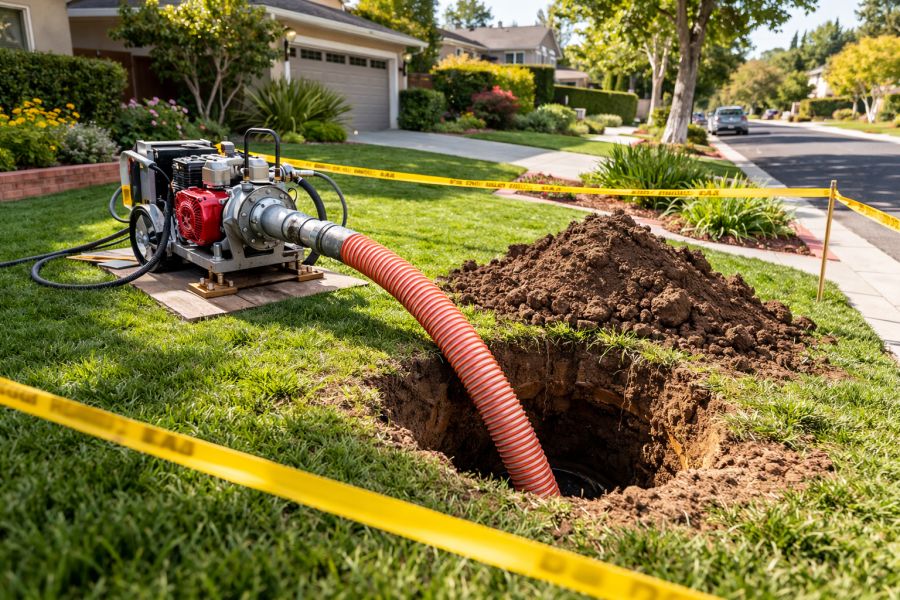
Both methods need access at the house cleanout and near the property line or curb. That second pit is where the S-Permit can become mandatory, since many curbside cleanouts in Sherman Oaks sit in the parkway. If the crew must excavate to expose the wye connection at the city main in the street, the S-Permit and the restoration standards control the job. The city requires cold milling and restoration of the asphalt beyond the limits of the cut, controlled-density fill backfill, and compaction verification. Those requirements are enforceable no matter how clean and fast the trenchless part of the work goes.
What the S-Permit covers and when it is required
LA City’s S-Permit is the workhorse permit for temporary use and minor construction within the public right of way. For sewer lateral replacement, it covers any excavation in the parkway or street, sidewalk removal and replacement, and any structure or equipment staging that blocks a lane or sidewalk. Many Sherman Oaks properties south of Ventura Boulevard have shallow laterals that transition within the parkway. Bringing that transition up to modern code typically means installing a property line cleanout assembly. If the cleanout lands in City property, the S-Permit authorizes the excavation and the concrete or landscape restoration.
There is often confusion between the LADBS plumbing permit and the S-Permit. The LADBS permit applies to the private property system, inspections at the interior stacks and lines, and verification that the system meets the California Plumbing Code. The S-Permit focuses on the area between the back of sidewalk and the centerline of the roadway where the lateral connects to City infrastructure. LA Sanitation and Environment remains the operator of the public sewer main, but the Bureau of Engineering controls the right of way, the cuts, and the restoration.
How a trenchless job moves through S-Permit steps without delays
On a typical 1950s ranch on Woodman Ave with a 55-foot clay lateral that fractures near the curb, a straightforward repair on private property could finish in one to two days. If the plan includes a new curbside cleanout and exposure of the city wye to verify the connection, the job touches City property. The S-Permit sequence adds time but is predictable when handled correctly. The crew files utility tickets with DigAlert 811 and waits for marks. A site plan shows the excavation window, sidewalk or parkway square footage affected, and a brief traffic control plan if a lane closure is needed. If the cut reaches the asphalt, an LADOT Temporary Traffic Control approval can be required for flagging or a short closure. The contractor posts a bond, provides insurance, pays the application and inspection fee, and schedules the field inspection. The Bureau of Engineering inspector checks trench shoring, compaction, and restoration to City Standard Plans before sign-off.
It reads like a lot, but in Sherman Oaks most trenchless jobs that need S-Permit oversight still finish within three to five working days once permits are issued, because the bulk of replacement still occurs from small access pits. The extra time falls on right of way restoration and the coordination window with the City, not on the pipe installation itself.
Technical preparation that keeps the permit process smooth
Documentation drives fast approval. A RIDGID SeeSnake or similar sewer camera inspection establishes the exact lateral length, material, diameter, and the distance to the city tap. Crews note whether the wye sits under sidewalk or asphalt. If the host pipe is cast iron for the first 5 to 10 feet and then clay, that mixed profile changes tool choice and possibly the need for limited descaling with a chain flail before lining. Hydro jetting at 4000 PSI clears roots and sludge so the camera can reach the tap. Jetting also preps the host pipe for CIPP if that is the selected method. Video captures and a simple sketch uploaded with the application help City staff see exactly where the excavation falls in the right of way. That context cuts questions and rounds of comments.
On pipe bursting scopes, crews confirm the clearance around gas and water laterals at the parkway. In Sherman Oaks, the gas service typically runs perpendicular at 18 to 24 inches depth to the meter, while older copper water laterals in 91423 and 91403 often cross near the same depth. Hand potholing confirmed by an inspector before the burst avoids a change order. CIPP often avoids that risk because the line remains in place, but it requires more stringent cleaning to meet structural liner standards.
Method selection when the parkway or street is involved
Both pipe bursting and CIPP can meet code and deliver decades of service. The right choice follows the host pipe condition and the location of the access pits. Pipe bursting is superior when the host clay has crushed segments or collapsed joints that would make a liner undersize or snag. It also delivers a larger internal diameter than a liner in a given host. Burst crews select HDPE sized to match or upsize the existing lateral, fuse joints on site with a McElroy or similar machine, and pull in a single day. In Sherman Oaks where driveways and walkways limit equipment footprint, TRIC or HammerHead systems are common for residential pull lengths.
CIPP is the better tool where the lateral has a good alignment but repeated joint leaks and root intrusion. It shines when the alignment runs under expensive hardscape that cannot tolerate the slight ground movement that bursting can cause. It also pairs well with a replacement of just the near-curb segment if the house-side ABS is in good shape. Perma-Liner installations in 4-inch host pipe can cure with steam or hot water in a few hours. Where access is limited to a small curb pit, inversion methods reduce setup size.
Where the right of way is involved, the City often prefers a property line cleanout for future maintenance. That preference may tip method selection because bursting requires enough clear pull area to set the pull head and winch. On tight parkways, CIPP sometimes fits the permit limits more cleanly by reducing excavation size.
Sherman Oaks corridors that consistently trigger S-Permits
South of Ventura Boulevard, many homes sit on deep setbacks with the lateral crossing lawn, sidewalk, and a strip of parkway before reaching the city main. Chandler Estates properties west of Hazeltine have mature landscaping and shallow parkways. Longridge Estates and Royal Woods on the hillside often tie in under the asphalt due to elevation differences, which brings pavement restoration into play. East of the Sherman Oaks Galleria along Sepulveda and Riverside, some multifamily buildings route their 6-inch laterals under the sidewalk where root intrusion from sycamore canopy becomes a chronic issue at the joint right below the curb. The fix requires exposure in the parkway or the street and an S-Permit every time.
These patterns are not edge cases. They repeat across 91423 and 91403, and show up along the Ventura Boulevard business corridor where commercial laterals run longer and shallower than expected. Even where the house line work is 100 percent trenchless, a curb pit or a property line cleanout across City property brings the Bureau of Engineering into the picture.
LADBS, LA Sanitation, and Bureau of Engineering roles clarified
Three City arms touch a trenchless sewer replacement that reaches the public right of way in Sherman Oaks. LADBS issues the plumbing permit for private property work. This covers the code compliance of cleanout placement, slope, materials transition from cast iron to ABS or PVC, and any venting or stack tie-in work on the property. LA Sanitation and Environment owns and operates the public sewer main beneath the street. The Bureau of Engineering manages the right of way and issues the S-Permit that governs excavation and restoration. Where a crew needs to tap directly into the public main or replace a wye, LA Sanitation coordination is required along with the S-Permit. On many residential laterals, the existing wye remains and a new lateral ties into it with verification at inspection, which keeps the focus on the S-Permit and the LADBS permit without a separate LA Sanitation tap permit.
City of Los Angeles does not have a citywide private sewer lateral ordinance that mandates point-of-sale inspection or replacement for Sherman Oaks single-family homes. That misconception often comes from policies in nearby cities. In Sherman Oaks, replacement is driven by failure, planned remodel, or required compliance for right of way work. The code still requires that the repaired or replaced segment meets California Plumbing Code and City Standard Plans, and the inspection sequence verifies that standard before backfill.
Documentation that cuts S-Permit processing time
The strongest submittals mirror the field reality. A site sketch shows the curb, sidewalk, parkway width, and the footprint of the pit. The sketch marks the measured distance from the property line cleanout to the city tap based on camera footage. It identifies nearby gas and water laterals and any street tree root zones. If the cut extends into the asphalt near Ventura Boulevard cross streets, a simple lane closure diagram that meets LADOT temporary traffic control notes reduces back and forth. Proof of insurance, a contractor’s bond on file, and a clear timeline for restoration complete the package. Many S-Permits for residential laterals in Sherman Oaks clear within one to two weeks when those items are complete at first pass.
What S-Permits add to cost and how to plan for it
Sherman Oaks owners often ask how much the right of way work adds. It varies by excavation size and whether asphalt is cut. As a shareable local benchmark rooted in recent Valley projects, an S-Permit application and inspection fee for a small residential excavation commonly lands in the $500 to $1,500 range. Contractors carry bonds that the City may hold against restoration, and deposits for street work can run from $2,000 to $5,000 on simple scopes. Traffic control for a short lane shift near a residential street can add $300 to $900. Pavement restoration costs depend on the square footage and City Standard Plans. Many Sherman Oaks asphalt restorations total $25 to $45 per square foot when cold milling, base repair, and a final cap are included. If the work stays in the parkway and sidewalk only, the cost impact drops, but concrete demo and replacement still must match the surrounding panel thickness and finish.
As for the trenchless work itself, pipe bursting on a 4-inch Sherman Oaks lateral typically runs from $140 to $250 per linear foot depending on access, depth, and surface constraints. CIPP lining for a 4-inch lateral commonly runs from $120 to $220 per linear foot. A 55-foot line from a house in 91423 to a curbside wye would often total $8,000 to $14,000 for the trenchless scope on private property. If a curb pit and parkway restoration are included under an S-Permit, many projects see an added $2,500 to $6,000. If asphalt is cut, that add can rise into the $6,000 to $12,000 range depending on the size of the restoration. These are practical ranges for planning, not quotes, and they reflect 2026 Valley market conditions and City restoration standards.
Timelines that match Sherman Oaks reality
Owners want the shortest path from backup to final sign-off. LADBS plumbing permits for residential sewer replacement are often issued same day or within two business days for straightforward scopes. S-Permit processing through the Bureau of Engineering for a small right of way excavation usually clears in 5 to 10 business days when submittals are complete. DigAlert utility marking adds 2 to 4 business days. The trenchless installation itself takes 1 to 3 working days, depending on method and access. Right of way restoration adds 1 to 2 days for sidewalk or parkway concrete and a scheduled day for asphalt cap if the street was cut. In practice, trenchless sewer line replacement in Sherman Oaks that includes limited right of way work finishes inside a two week window once the permits are in motion. Jobs that stay on private property often complete within a week.
Inspection checkpoints and what inspectors look for
For LADBS, the inspector checks slope, pipe material transitions, and cleanout placement. A property line cleanout must be accessible and sized per code. Transitions from cast iron to ABS or PVC require approved couplings. The new lateral must maintain required grade. For S-Permit work, the Bureau of Engineering field inspector checks shoring if the trench is deep, verifies compaction and backfill material, approves sidewalk or parkway restoration details, and checks sewer repair in sherman oaks that the asphalt restoration meets City thickness and cold mill requirements across and beyond the cut edges. If the wye is exposed, the inspector confirms condition and connection. Where the public sewer connection is touched, LA Sanitation may also check the connection before backfill. Crews submit as-built sketches where required. The right of camera inspection way goes back to serviceable condition before the permit closes.
How building archetypes and Valley zones change the spec
In 1940s and 1950s post-war ranch homes across central Sherman Oaks, clay tile laterals often sit shallow and run straight to the main. Pipe bursting is often ideal if the house yard can host the pulling setup. On 1960s and 1970s split-levels near Valley Vista and the Sherman Oaks Hills foot, the alignment can jog around additions or pools, which can slight-favor CIPP to follow a stable host path. Multifamily near Ventura Boulevard and Riverside Drive may carry 6-inch laterals with higher flow rates, which make CIPP sleeve selection and resin cure profile more critical. In hillside areas like Royal Woods, elevation changes can force the city tap farther into the street, which can raise the chance of asphalt restoration and influence the budget. Where LA DWP hillside water service runs 80 PSI or higher, contractors also watch for slab leak histories that can point to broader system age, and plan for a property line cleanout that allows future maintenance without a new right of way cut.
Equipment and materials that pass inspection in Los Angeles
Inspectors in Sherman Oaks are used to trenchless. They expect pipe bursting installations to use fused HDPE sized to match the host and installed per ASTM F1962. Crews use pull head pneumatic bursting or static systems matched to soil conditions and depth. For CIPP, they look for liners that meet ASTM F1216 with submittals for resin type, cure method, and thickness. Perma-Liner is accepted when the installer follows manufacturer instructions. House-side piping typically transitions to ABS Schedule 40 or PVC Schedule 40. Transition couplings must be shielded and approved. Where cast iron remains within the footprint of a building, replacement with cast iron DWV is often specified for noise control, with ABS or PVC beyond the footprint. Property line cleanouts and caps must be accessible, labeled, and compatible with standard rooter service equipment. Sewer camera inspection reports and photos help document the pre- and post-condition for both LADBS and BOE files.
Sewer camera inspection is not optional in Sherman Oaks
Before committing to any replacement method, a video inspection captures what trenchless will have to solve. It identifies the exact material sequence, the presence of sags, breaks, or bellies, and the distance to the tap. In Sherman Oaks, where laterals often change material two or three times between the house and the street, that information prevents method mistakes. A camera with a sonde locator pinpoints the wye location and depth under the parkway or street, which is vital for S-Permit drawings and for minimizing excavation size. The footage also becomes a record that supports a case for lining or bursting under the City’s standards and reduces risk of delays during inspection.
Pre-treatment and cleaning that make trenchless line up with City standards
Hydro jetting at 4000 PSI with a root cutter nozzle clears intrusions that cabling will not remove. In pre-1970 Sherman Oaks clay, roots repeat every 3 to 5 feet at joints. A complete jet pass opens the line for a clean camera survey and prepares the host for CIPP. Where cast iron is present near the property line, a chain flail or similar descaling tool removes interior tuberculation so the liner bonds correctly. For bursting, cleaning focuses on removing blockages that would deflect the bursting head. Crews protect internal systems by verifying traps and vent status before jetting. All cleanouts are sealed after work to prevent inflow of debris during the right of way portion of the job.
Right of way restoration details that trip up DIY planners
The City requires restoration per standard plans. For sidewalk, the replacement panel must match thickness, score pattern, and finish. For parkway, compaction and topsoil restoration must leave the grade flush with the adjacent area. For asphalt, the City expects a T-cut with cold mill beyond the trench edges, base repair if disturbed, and a final cap that meets thickness specifications for the street classification. These requirements are not negotiable. Cutting just to the edges of the trench and topping it with a patch does not pass. Crews schedule asphalt cap after utility hold periods when required and post any temporary plate correctly with transitions. Proper restoration avoids callbacks and secondary costs.
Shareable Sherman Oaks data point
On recent Sherman Oaks projects south of Ventura Boulevard in 91423, trenchless pipe bursting or CIPP that stays on private property totals 1 to 3 working days and $8,000 to $14,000 for a typical 50 to 60 foot 4-inch lateral. The moment a curb pit in the parkway is added, owners should plan on an S-Permit window of 5 to 10 business days and a cost impact of $2,500 to $6,000 for parkway concrete and restoration. If asphalt is cut to reach a deep wye, the right of way add rises to $6,000 to $12,000 and adds one day of field time for milling and cap. These numbers reflect actual Valley patterns and City restoration requirements, and they explain why many owners choose a property line cleanout placement that keeps future maintenance out of the street.
A practical example from the Valley
A 1952 ranch near Westfield Fashion Square in 91423 backed up twice in six months. A camera inspection found a fractured clay joint 48 feet from the house and root intrusion at four joints. The wye sat under the parkway at 5 feet deep. The owner chose CIPP to avoid any risk to a stamped concrete driveway. The crew hydro jetted at 4000 PSI, descaled a 6-foot cast iron segment near the property line, and inverted a resin-saturated liner meeting ASTM F1216. An S-Permit authorized a 3-foot by 4-foot parkway pit to verify the tie-in and place a property line cleanout, with sidewalk untouched. The BOE inspector checked shoring, compaction, and concrete finish in a single visit. Total field time ran two days for lining and one day for restoration. The project stayed out of the asphalt and closed in under ten working days from application to final. The owner avoided $7,000 or more in asphalt restoration that a street cut would have triggered.
What triggers S-Permit review most often in Sherman Oaks
Patterns repeat across the neighborhood. The following situations most often require an S-Permit review because they place work in the public right of way:
- Installing or replacing a property line cleanout in the parkway near the curb
- Exposing or replacing the sewer wye connection beneath the street or sidewalk
- Excavating in the sidewalk or parkway to access a collapsed segment near the city main
- Staging trenchless equipment or a spoil pile within a travel lane or blocking a sidewalk
- Any cut or restoration to asphalt or concrete within the right of way
Submittals that speed BOE approval for a trenchless replacement
Clear submittals reduce questions. Owners and contractors who close S-Permits quickly in Sherman Oaks usually include these items with the application:
- A plan-view sketch with dimensions from property line to curb and to the city tap depth
- Utility markouts and 811 ticket references for gas and water crossings
- A brief traffic control note for any lane or sidewalk impacts
- Proof of insurance, contractor bond, and the LADBS plumbing permit number
- Pre- and post-jetting camera footage documenting the host pipe and the tap
Where Valley-wide experience saves time on Sherman Oaks streets
Crews that work daily from Encino 91436 and 91316 through Studio City 91604 and Van Nuys 91401 and 91411 learn how the City reviews small residential S-Permits. They also learn the local soil and street restoration quirks that add or cut time. A small example matters. On Ventura Boulevard side streets near the Sherman Oaks Galleria, asphalt cuts often sit on older base that crumbles at the edge. Successful projects anticipate a wider mill and cap to prevent edge failure. On hillside streets near Royal Woods, steeper grades change traffic control notes, and inspectors often ask for earlier morning work windows to limit congestion. Keeping those details in the plan avoids added days. Valley crews that run trenchless daily also carry the right mix of materials on the truck. That includes HDPE for pipe bursting with fused joints that pass inspection, ABS or PVC for house-side transitions, approved shielded couplings, and cleanout assemblies that match City requirements.
Codes and standards that guide every inspection
The California Plumbing Code sets the material and slope requirements for private sewer systems. LADBS enforces those standards on private property. For right of way work, the City of Los Angeles Bureau of Engineering applies City Standard Plans and the Greenbook for backfill and pavement restoration. ASTM F1962 and ASTM F1216 provide the performance standards for pipe bursting and cured-in-place lining. LA County Sanitation District standards may apply on properties near jurisdictional boundaries, but Sherman Oaks single-family homes typically tie into City of Los Angeles sewers and follow City standards. Title 24 governs energy work and is not part of a sewer permit review, though LADBS issues both plumbing and HVAC permits at the same Van Nuys office many Sherman Oaks owners use for in-person questions.
Why trenchless remains the first choice for Sherman Oaks properties
The total project picture matters. On a 55-foot lateral under a driveway, open-trench excavation would require cutting, removing, and re-pouring a long ribbon of concrete, with 5 to 10 working days of site disruption and heavy restoration costs. Trenchless pipe bursting or CIPP frequently completes in 1 to 3 days, preserves hardscape, and produces a uniform, root-proof system. Even with an S-Permit and a small parkway pit in play, trenchless remains faster and less intrusive. For properties with well-established front yards in Chandler Estates or the south of Ventura corridor, that difference protects curb appeal and resale value while solving a recurring sewer backup problem for the long term.
Service area coverage across Sherman Oaks and the Valley
Trenchless sewer line replacement is active across Sherman Oaks zip codes 91423 and 91403, with frequent dispatch into Encino 91436 and 91316, Studio City 91604, Van Nuys 91401 and 91411, and Toluca Lake 91602. Projects near Ventura Boulevard, the Sherman Oaks Galleria, and Westfield Fashion Square often carry the parkway or sidewalk access pits that bring the S-Permit into scope. Hillside alignments above Valley Vista and Mulholland Drive can run deeper and closer to the street, making a small asphalt cut more common. Each zone changes the permit and restoration details, but the trenchless replacement core stays constant.
What owners can expect from a well-run Sherman Oaks trenchless project
A competent contractor preps with a complete camera inspection, documents the alignment, and selects the method by failure mode. They pull the LADBS plumbing permit and file the S-Permit if the plan touches City property. They hydro jet roots at 4000 PSI, prep the host, and install either a structural CIPP liner that meets ASTM F1216 or a fused HDPE lateral via pipe bursting that meets ASTM F1962. They coordinate inspections, then restore the parkway or asphalt to City standards, returning the right of way to serviceable condition. They leave a property line cleanout accessible for future rooter service. That pattern holds across Sherman Oaks single-family, duplex, and small multifamily properties.
Final thoughts for Sherman Oaks homeowners evaluating trenchless replacement
For homeowners in Sherman Oaks facing repeated backups or clear camera evidence of failed clay or cast iron laterals, trenchless methods deliver a durable fix while protecting landscaping and hardscape. The S-Permit process is a normal part of the job when a curbside pit or city connection exposure is needed. It should not deter a replacement that will otherwise stop flooding, odor, and property damage. Permit compliance prevents fines, restores the public right of way to City standards, and creates a clean record if the property is refinanced or sold. With the right method selection and complete submittals, a trenchless project that includes limited right of way work can still move from first survey to restored street in a matter of days, not months.
Why Sherman Oaks homeowners call ServiStar Plumbing and HVAC for trenchless sewer line replacement
ServiStar Plumbing and HVAC performs trenchless sewer line replacement in Sherman Oaks and across the San Fernando Valley every day, including pipe bursting and CIPP lining with ASTM F1962 and ASTM F1216 compliance. The team manages LADBS plumbing permits and LA Bureau of Engineering S-Permits for parkway and street work, coordinates inspections, and restores the right of way to City standards. CSLB licensed under C-36 Plumbing and C-20 HVAC classifications, bonded and insured, with BBB Accreditation and Google Guaranteed status. Dispatch operates 24 hours a day from 13351 Riverside Dr, Suite 414, Sherman Oaks, CA 91423, covering 91423, 91403, 91436, 91316, 91604, 91401, 91411, and 91602. Free in-home estimate, upfront flat-rate pricing on standard scopes, financing available, and manufacturer-certified installation where equipment applies. For same-day trenchless sewer line replacement in Sherman Oaks, including S-Permit management, call +1-818-873-0613 or visit https://www.servistarplumbingandhvac.com/plumbing/trenchless-sewer-line-replacement/.
Servistar Plumbing and HVAC
13351 Riverside Dr Suite #414
Sherman Oaks,
CA
91423
Phone: (818) 873-0613
Website: servistarplumbingandhvac.com